Sharia May Seem Exotic To Many Who Live Outside Areas With Large Muslim Populations. What Do People in Aceh Think about It?
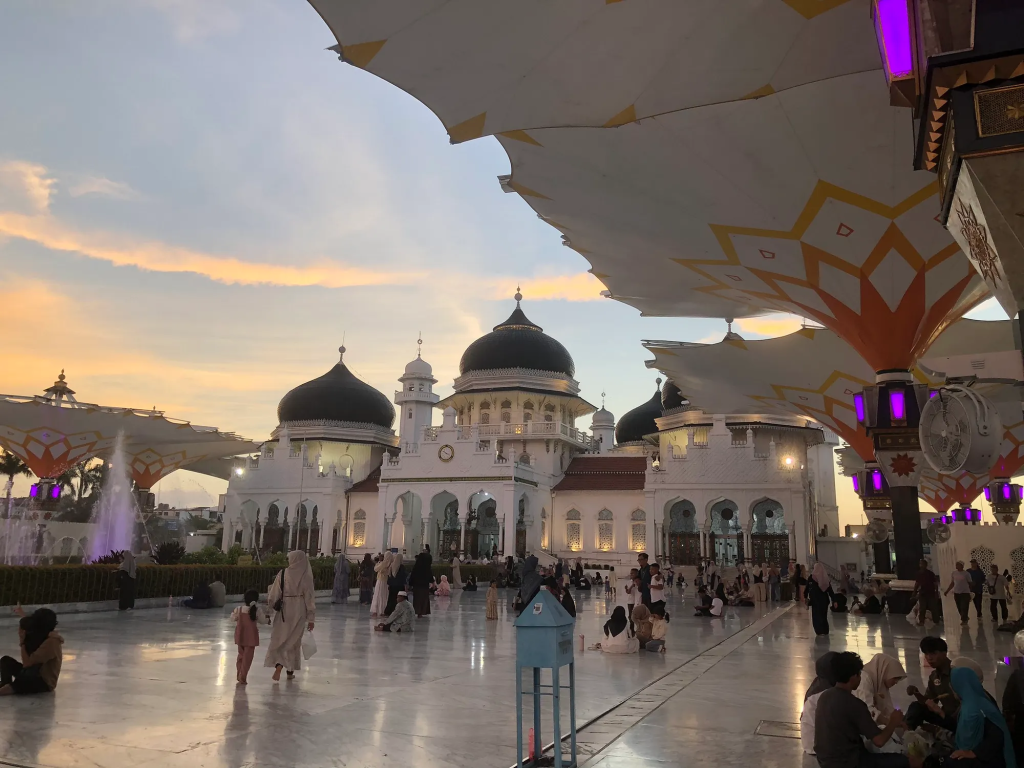
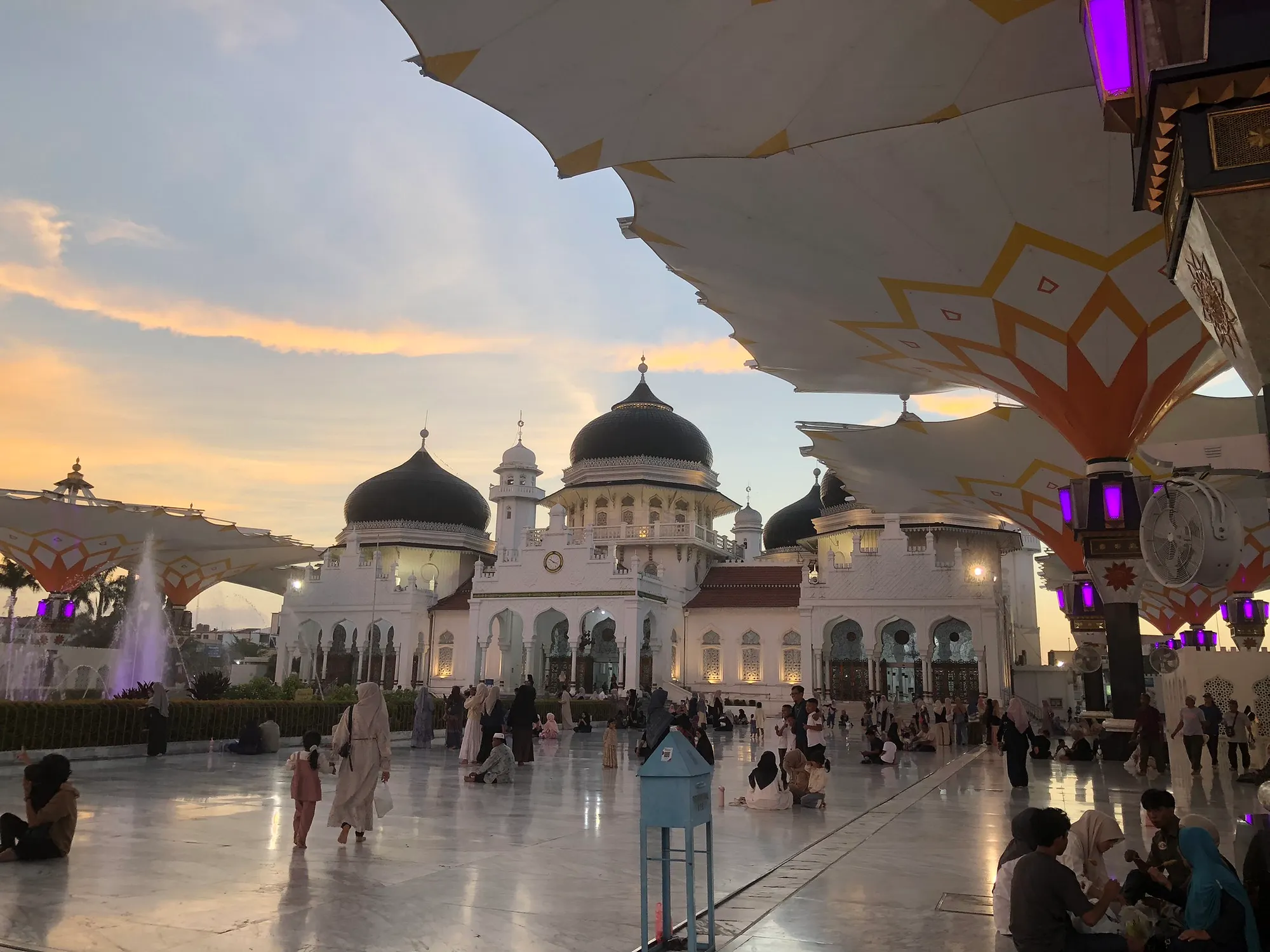
Sunset at Baiturrahman Grand Mosque in Banda Aceh, Aceh Province, Indonesia
The way Aceh interprets Sharia law has caused it to ban movie theaters, swimming pools, and indoor concert venues. Crimes in Aceh include gambling, khalwat (being in a secluded place with someone from the opposite sex who is not family), eating pork, alcohol, homosexuality, failing to wear a hijab as a woman, and failing to attend Friday prayers. Violators risk being publicly canned.
Most regions in Indonesia and Malaysia have an Islamic majority population. However, Aceh is unique because it is the only province in Indonesia, and one of only two legal entities in Southeast Asia, where Sharia is applied at the criminal level (Brunei being the second).¹ Nonetheless, in Malaysia and many parts of Indonesia, Sharia courts still exist to enforce Islamic law in civil cases between muslim citizens.²
It seems important to note that some of Aceh’s laws only apply to muslim Indonesians. For example, as a non-muslim tourist in Aceh, I have never been required to attend Friday prayer. Also, I have never seen Christian Indonesians nor tourists wearing hijabs in the province.
I should also note that the way Aceh applies Sharia law is less extreme than most other regions where Sharia is implemented criminally. Aceh never goes as far as to kill or amputate people who violate Sharia. Meanwhile, in countries like Saudi Arabia and Brunei, homosexuality warrants the death penalty and thieves may have their hands amputated.¹
Since this series explores how ideas, ideologies, and religion impact communities and their environment, I want to explore the impact Sharia has on the people of Aceh. While I lack the resources to conduct a large scale quantitative study surveying the way people have been affected by Sharia, I can describe the experiences of different people who I have met in Aceh.
Almost everyone who I have spoken with share two characteristics:
1) They are in their 20s.
Most people who would speak to me about their experience under Sharia have been around the same age as me. This is important because some people claim that Sharia is more popular among older people than younger people. However, I have never been able to verify whether this is true.
2) Most of the people who I have talked to about their life under Sharia have been female.
There has only been one male I have talked with about this topic. This is unintentional. The only reason this is the case is because I have happened to meet more females in Aceh than males. Nevertheless, it is important because Sharia impacts women in different ways than men (i.e. women must wear hijabs).
For the purposes of this blog, I will make these individuals fictional characters. I do this for two reasons:
(1) To Protect The Individuals
If I provide details about the people I have spoken to, then the government of Aceh or people living within Aceh may be able to identify them. If they express unpopular opinions, I believe it is probable that they will face intense social pressure, ostracization, or potentially more severe consequences for their beliefs. For this reason, I want to share their thoughts through fiction.
(2) I Am Telling The Story of People Filtered Through My Own Experience
Although each character represents a real person, I cannot be certain that my understanding of their experience reflects their true experience in the most accurate manner. Due to linguistic and cultural differences, it seems likely that the way I interpret their opinions comes from my own biases and pre-conceived understandings about the world. To avoid conflating my understanding of someone’s perspective with their true perspective, I have decided to make the characters I write fictional.
The intention of this article is to explore what life is like for people living under Aceh’s Sharia law. It is not to judge the situation. It is not to convince readers that Aceh’s Sharia is good of bad. It is only to share the perspectives of others as I understand them.
- Jakarta Post News Desk. 2018. “Q&A: What You Need to Know about Sharia in Aceh.”
- Quach, Trung. 2026. “Library Guides: Southeast Asian Region Countries’ Law: Indonesia.” and Stepanovic, Anastasia. 2026. “Library Guides: Southeast Asian Region Countries’ Law: Case Law.”
Character 1: The Content
I think that the content represents the most common perspective I have encountered in Aceh. Like many Acehese, she has little experience being outside the province. She has only once left Aceh and it has only been for one weekend. To her, Aceh’s Sharia law is the norm. It is all she has ever known.
She might think banning cinemas is a little too strict, but she also seems to feel a bit apathetic towards the policy. After all, “If I want to see a movie, I can just watch it from my home.” Why would one need to go to a movie theater when one can watch movies anywhere?
She has never been in public without a hijab. To her, wearing a hijab might feel like wearing a shirt. It might feel inappropriate or strange to be without one. She also cites the many advantages to wearing one: “a hijab protects me from things like men, bugs, and UV rays.” However, perhaps the most important reason to wear a hijab for her has to do with her own identity. “To be honest,” she confides, “I would not feel like myself without one.”
For the content, Aceh’s rules appear to work. Nevertheless, she seems to understand why those who wish for greater freedom move elsewhere. She can understand why some Acehese decide to move to places with fewer rules. For her, however, she is content to stay in Aceh.
Character 2: The Moralist
Unlike the content, the moralist’s opinion about Sharia seems to be less neutral. Instead, it seems to be one of strong support.
As a young man, he had disliked Aceh’s strict rules. He had moved to other parts of Indonesia and Malaysia to experience a life where people had more freedoms. However, while abroad, he had begun to see the disadvantages to this freedom. This experience has seemed to make him a strong supporter of Aceh’s Sharia law.
Living abroad, he saw how people got into trouble when there was alcohol or khalwat (being with members of the opposite sex). He worries that if Aceh were to loosen its laws, more Acehese would find themselves in the tough situations he has witnessed elsewhere.
“Last year, 60 Acehese, tested positive for HIV,” he claims.³ “Imagine how high the HIV rate would be if we were to discard our rules in Aceh.”
Nevertheless, the fact that almost 60 Acehese have tested positive for HIV last year leads him to believe Aceh must do more than only enforce strict laws. Specifically, he believes that they need to do more to educate people. “Unfortunately in Aceh, it is taboo to even talk about sex.” He explains that this means when a person hits puberty, they have little understanding about what they are feeling. This lack of education, he believes, leads to people making poor decisions and getting married before they are ready.
“The strict rules are good, but we need education too,” he explains. The combination of these two conditions he thinks, is how society can best prevents the unwanted outcomes caused by immature sexual relations and partying.
3. His statistic seems to be about right. According to the UN, about 50 new cases of HIV are reported in Aceh each year. See, Gaspar, Miklos. 2025, for more information.
Character 3: The rebel
While many around her support Sharia, she and her friends see hypocrisy. “Wear your hijab” people scold her. However, she observes that sometimes the people who scold her are the same people who drink alcohol in private.
Although Islamic men in Aceh are never suppose to wear shorts in public, it is not uncommon to see men running in them. She wonders why people never seem to complain when men wear shorts, but people care about women wearing the hijab.
“Nowadays, people my age rarely even pray five times a day. People just care that women cover. It’s mysogyny!” She exclaims. It leaves her wondering why the most important aspect of Aceh’s Sharia seems to be about a woman wearing a hijab and not something more central to Islamic faith like praying.
For her, she hates Aceh’s restrictions. Whenever or if ever she has the opportunity to leave Aceh, then she intends to leave.
Final Thoughts
I have been very lucky to meet many different kinds of people in Aceh. My hope is that these three fictional characters can help illustrate the different kinds of experiences people have living under Aceh’s Sharia law. To those Who I have met in Aceh who have been willing to share their experiences with me, my sincere thanks goes out to you.
Citations
Gaspar, Miklos. 2025. “World AIDS Day 2025: Community-Led Monitoring Helps Increase Access to HIV Treatment in Aceh.” Indonesia, December 1. https://indonesia.un.org/en/306368-world-aids-day-2025-community-led-monitoring-helps-increase-access-hiv-treatment-aceh.
Jakarta Post News Desk. 2018. “Q&A: What You Need to Know about Sharia in Aceh.” The Jakarta Post, March 4. https://www.thejakartapost.com/news/2018/03/04/qa-what-you-need-to-know-about-acehs-sharia-law.
Lee, Kong Chian. 2023. “Tales of the Unexpected: Contesting Syari’ah Law in Aceh, Indonesia.” Stanford University, February. https://aparc.fsi.stanford.edu/southeastasia/news/tales-unexpected-contesting-syariah-law-aceh-indonesia.
Puri, Tanmay. 2026. “WATCH: 21 Lashes for a TikTok Kiss? Couple Publicly Caned under Sharia Law.” International Business Times UK, July 3. https://www.ibtimes.co.uk/indonesian-couple-publicly-caned-tiktok-livestream-kiss-aceh-1806666.
Quach, Trung. 2026. “Library Guides: Southeast Asian Region Countries’ Law: Indonesia.” Unimelb.Libguides.Com, August 20. https://unimelb.libguides.com/c.php?g=930183&p=6721974.
Stepanovic, Anastasia. 2026. “Library Guides: Southeast Asian Region Countries’ Law: Case Law.” Unimelb.Libguides.Com, August 20. https://unimelb.libguides.com/c.php?g=930183&p=6721989.